Why Investors Care About Crypto as an Asset Class
Once the you understand the mechanics of crypto, the next question naturally follows. Why has this space attracted so much investor attention over the past couple of years?
The answer lies in a combination of performance, scale, and long term direction.
Bitcoin is the most obvious place to start.
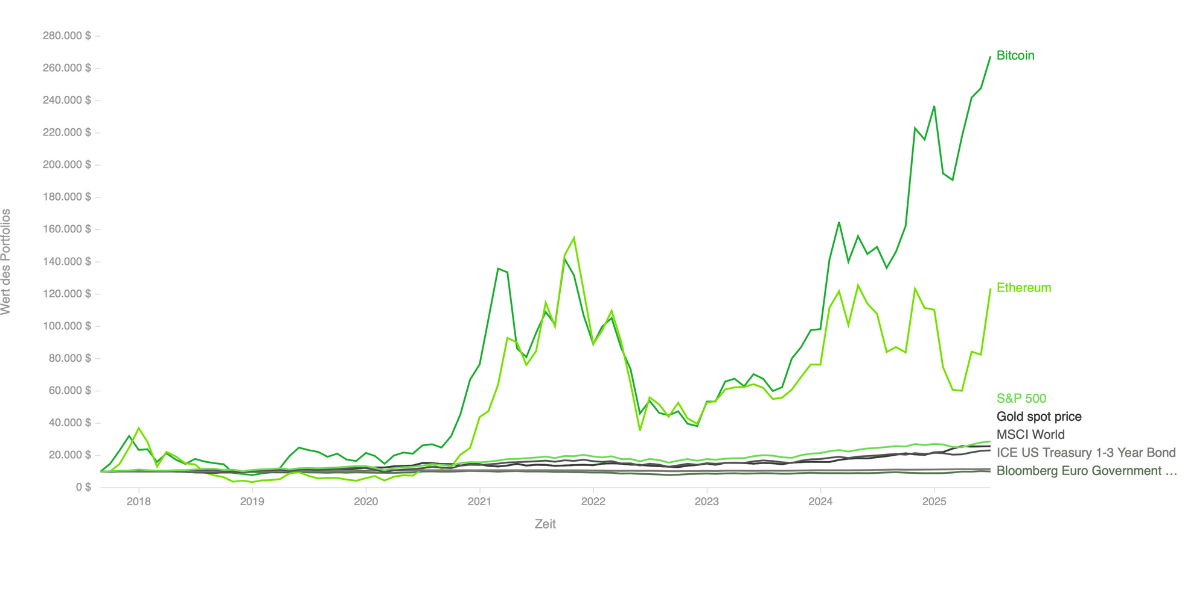
Over the past ten years, Bitcoin has delivered close to a 50 percent annualised return on average. This is not the result of a single lucky cycle or a short speculative burst. It is the outcome of sustained growth across multiple market environments, including periods of severe volatility and deep drawdowns.
Very few asset classes in modern financial history have produced comparable long term performance at this scale.
What makes this particularly interesting is Bitcoin’s relative size.
Despite its growth, Bitcoin’s total market capitalisation is still below two trillion dollars. Gold, by comparison, sits closer to 35 trillion dollars.
In other words, Bitcoin represents only about six percent of gold’s market size.
Yet the two assets share several important characteristics. Both have a limited supply that cannot be expanded at will. Both exist outside direct government control. And both are increasingly viewed as long term stores of value rather than short term trading instruments.
From an investor’s perspective, this creates a clear asymmetry.
Bitcoin offers properties similar to gold, but with a far smaller market and a much shorter adoption curve. Historically, assets that combine scarcity with growing adoption tend to experience outsized price appreciation as they mature.
Performance alone, however, is never enough to sustain long term interest.
Accessibility plays an equally important role.
Crypto markets are global by design. They operate continuously, without opening hours, and are accessible to anyone with an internet connection. There are no borders to cross and no gatekeepers deciding who is allowed to participate.
This dramatically expands the potential investor base.
In traditional markets, access to high growth opportunities has often been limited by geography, regulation, or infrastructure. Crypto removes many of these constraints, which in turn increases long term demand.
Another major shift has taken place on the regulatory front.
For many years, unclear regulation was one of the biggest barriers for serious investors. That environment is now evolving.
In the United States, new frameworks such as the Clarity Act and the Genius Act aim to bring more definition and oversight to digital assets. While regulation does not eliminate risk, it reduces uncertainty, and uncertainty is what markets tend to price most aggressively.
Clearer rules make it possible for institutions to participate responsibly. They allow asset managers to create compliant products and give investors confidence that crypto is becoming part of the financial system rather than remaining outside of it.
This shift is already visible in market structure.
Spot exchange traded funds have been approved for Bitcoin, Ethereum, and Solana. These products reflect real demand from institutional investors, pension funds, and wealth managers who want exposure without changing their entire operational setup.
It is unlikely that this trend stops with these three assets.
As the ecosystem matures, more high quality Layer 1 networks are expected to follow. What those networks are and why they matter will be explained in a later chapter.
When viewed together, the investment case becomes clearer.
Crypto combines long term outperformance with global accessibility, increasing real world usage, and a regulatory environment that is gradually becoming more defined. Each of these factors reinforces the others and contributes to sustained demand over time.
This does not mean the path is smooth.
Crypto remains volatile, and drawdowns are an inherent part of the asset class. But for investors who think in terms of years rather than weeks, the central question begins to shift.
It is no longer only about the risk of investing in crypto. It becomes a question of what the risk might be of having no exposure at all.
That is where many serious investors find themselves today.
Now let's discuss what place crypto can play in your investor portfolio.